Wednesday, 12 February 2020

CHITHARAL JAIN MONUMENTS / CHITHARAL ROCK JAIN TEMPLE ( MALAIKOVIL ), VELLAMCODE, KANYAKUMARI DISTRICT, TAMIL NADU.

25th January 2020.
The visit to this Chitharal Jain Monuments at Vellamcode in Kanyakumari District was a part of Nanjil Nadu Heritage Walk organized by Yaaooyaakay and Celebrate Kanchi in association with Tamil Nadu Tourism and Development Department, Kanyakumari, scheduled on 24th to 26th January 2020. This Jain monument is under the control of Tamil Nadu Archaeological Department. Steps are paved neatly to climb up the hill. The hill is about 400 feet high and has many natural caves. The hill has many natural caves.

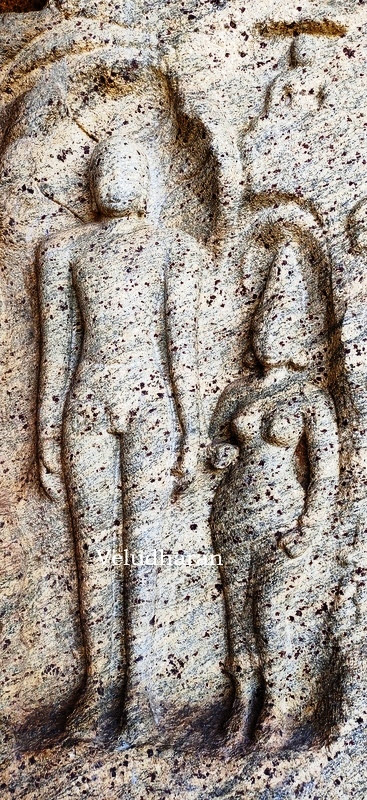
As per the inscription this hill was mentioned as Thiruchcharanathu malai. This hill might have obtained this name due to the Jain monks lived here.  In one of the cave facing North – west direction Jain Tirthankaras like, Neminath, Pashvanath, Mahavir, Yakshi Padmavathy, Sithayika and Tirthankaras are chiseled in the form of bas-reliefs. The names of the persons who donated for creating these bas-reliefs are also inscribed.

On the other side, the natural cave is being used for the built up temple, with 3 sanctums, a mahamandapam and a mukha mandapam. The maha mandapa is supported with pillars and the ceiling has the Gajalakshmi panel. The Pillars has the Tirthankaras, animals, Saints, Monks,  dancers and Hindu bas-reliefs. The Pillars are supported with Lion pothyals / Capital.  Two Dwarapalakas are at the entrance of the Mahamandapa.  The names of the donors are inscribed at the pedestal. The Mukha mandapa is supported with 6 pillars. The vimana above the sanctum on the rocky surfaced is found unfinished.  There is a water pond or pali in front of the temple.

HISTORY AND INSCRIPTION
There are 17 inscriptions found in this temple and 12 are directly related to Jainism. The latest one belongs to Sri Moolam Thirunal, the King of Travancore. Believed that this was built during Aay Kings and 9th Century Aay King Vikramaditya Varaguna’s inscription is the oldest one. The inscription records the gift of ornaments to Bhatari ( May be Yakshi – Bhagavathy ? ). Latter during 13th Century this temple was converted in to Hindu Temple, but the three sanctums houses the images of Bhagavathy, Mahavir and Parshvanath.  The 1250 CE, inscription records, one Tamilpallavarayan, belongs to Kizhvembenadu donated money to this Bhagavathy Amman for conducting regular poojas. It may be concluded that this temple was a Jain Temple till 13th Century and latter converted to Hindu temple.  The previous inscriptions do not mentions the Bhagavathy’s name.  

It was learnt that this temple was renovated a Jain Nun called Muttavalai Narayana Kurathiyar, who also offered Lamp and golden flower.  The male and female monks/ nuns are referred as Kuravar and Kurathiyar.  This is very much similar to the inscription found in Kalugumalai and also they belongs to Kottaru ( a place in Kanyakumari District ).

TIMINGS:
Visitors are allowed between between 08.00 hrs to 17.00 Hrs.

HOW TO REACH:
Chitharal is about 9 KM from Marthandam, 40 KM from Nagercoil, 55 KM from Kanyakumari, 118 KM from Tirunelveli and 800 KM from Chennai.

LOCATION: CLICK HERE


 Mahavir
 Bhagavathy
 Parshvanath


--- OM SHIVAYA NAMA---

Tuesday, 11 February 2020

SHRI PARTHASARATHY TEMPLE, PARTHIVAPURAM, ARUDESAM, KANYAKUMARI DISTRICT, TAMIL NADU.

25th January 2020.
The visit to this Shri Parthasarathy temple at Parthivapuram in Kanyakumari District was a part of Nanjil Nadu Heritage Walk organized by Yaaooyaakay and Celebrate Kanchi in association with Tamil Nadu Tourism and Development Department, Kanyakumari, scheduled on 24th to 26th January 2020. This was the first temple’s visit on the second day. This place was called once as Parthivasekarapuram. There were 3 types of learning centers functioning for the Brahmins and Kshatriyas  during Aay King’s periods.

Moolavar  : Sri Parthasarathy.

Some of the salient features of this temple are...
The temple is facing west with an entrance arch. Loose sculptures under worship are on the right side of the entrance arch. A balipedam is after the entrance arch. A stone temple with sanctum and arthamandapam is on the right side on an elevated platform. Nagars are on the left side. In the outer prakaram sannadhi for Kanteswara Lord Shiva, Varaha Swamy, Narasimha, Ayappa and Vadakkum Perumal. Moolavar Sri Parthasarathy is in standing posture in the sanctum. There is no sannadhi for  Thayar and Garudan.

ARCHITECTURE
The prakara around the sanctum sanctorum is almost empty except madapalli. A 4 Pillar mandapa is in-front of the main sanctum sanctorum. The extended front mandapa covers both out side and inside. The koshtams are empty. The sanctum sanctorum is built on a pathabhanda adhisthana with tripatta kumuda. A 2 tier stucco vimana is over the sanctum. In valabi Bhooth vari is shown. The prasthram is of kapotha style with kood. Above the prasthara, is yazhi vari, various animals are shown. The Vimana has only 8 deity images, which includes Brahma. Also 8 Lion images are found on the top level. Except Vimanam thangis no other stucco images of deities are found. The front and corridor mandapas, Shiva sannadhi and Vadakum Perumal sannadhis are built in Kerala style with Mangalore tiled roof.
  
HISTORY AND INSCRIPTIONS  
This temple was built by the Aay King Karunandadakkan ( 857 – 885 CE). This place was called as Parthivasekarapuram which has got corrupted to the present name of Parthivapuram. 

This place has got a 5 leaves Copper plates. In the 1st leaf of copper plate, inscriptions records that the king donated many lands in lieu of Uzhakkuvilai, to Munsirai Village sabha. ( it was learnt that a female elephant was let free to roam. The roamed area was gifted to this temple ). The King established a Parthivakesapuram Salai ( a residential learning centre / School  ) similar to Kanthalur Salai with a Vishnu temple.  

The second leaf of the copper plate records the gift of land to the temple towards temple servants, flower, burning of perpetual lamp and celebrations. The temple servants are supposed to bring 30 pots of water daily for the abhishekam, garlands and oil to burn the perpetual lamps. 

The third leaf of the copper plate records the gift of land to Shantikarars, Akanazhikai servants, Panchakavyam sprayers, the persons who give flowers and Musicians.  

The 4th and 5th leaves of the copper plate  records the details of the School where Veda teachings was taught, number of teachers & Students ( 95 students ), the rules & regulations / code of conduct to be followed, the process of learning, collection of Taxes,  the punishment for the defaulters, etc,.

5 inscriptions of this temple are recorded. The Kaman Dhadakkan’s ( 923 CE ) inscription is considered as the oldest. This king donated land to this temple. Another inscription records the donation of perpetual lamp.

The temple is under the control of Archaeological Survey of India ( ASI ).
  
THE TEMPLE TIMINGS
The temple will be kept opened between 04.30 hrs to 11.00 hrs and 16.30 hrs to 20.00 hrs.

CONTACT DETAILS:
The following mobile numbers may be contacted for further details.9715343340, 8303148806 and 9443166457.

HOW TO REACH:
Parthivapuram is 20 KM from Thiruvattaru, 20 KM from Thuckalay, 41 KM from Nagercoil, 52 KM from Kanyakumari and 820 KM from Chennai.
Nearest Railway Station is Nagercoil.

LOCATION: CLICK HERE


 A Shiva Sannadhi 
 Entrance arch

 Loose Sculptures

 Inscription of the adhisthana
 Inscription in the front mandapa
---OM SHIVAYA NAMA---

Monday, 10 February 2020

BHOOTHALINGASWAMY TEMPLE / BOOTHALINGA SWAMY TEMPLE – SIVAGAMI AMBAL TEMPLE, BHOOTHAPANDI, KANYAKUMARI DISTRICT, TAMIL NADU.

24th January 2020.
The visit to this rock cut Bhoothalingaswamy cave temple at Bhoothapandi in Kanyakumari District was a part of Nanjil Nadu Heritage Walk organized by Yaaooyaakay and Celebrate Kanchi in association with Tamil Nadu Tourism and Development Department, Kanyakumari, scheduled on 24th to 26th January 2020. After the Kurathiyarai cave temple’s visit, our next destination was to Bhoothapandi, which was about 5.4 Km from Kurathiyarai. This place Bhoothapandi is on the banks of  Pazhayar River, at the foothills of Thadaga malai. The freedom fighter Mr P Jeevanandham, hails from this place.

Moolavar  : Sri Bhoothalingaswamy / Bhoothalinga Swamy
Consort    : Sri Sivagami Amman

Some of the Salient features of this temple are...
This is a Rock cut cave temple facing east with a 3 tier Rajagopuram on the west side. Sri Bhootha Vinayagar is just opposite to the Rajagopuram. The Sanctum sanctorum is of Rock cut cave in a small hillock with out trees.  Two stucco images of  Bhoothas are on the Rajagopuram.  The temple, has the circumambulatory path to reach the temple, around the hillock. Balipedam, Dwajasthambam and Nandhi are in front of the temple.

Sanctum sanctorum is  a Rock cut cave and the moolavar is also excavated from the mother rock ( Banam cannot be taken out from the avudayar ). There is no circumambulatory path around the sanctum sanctorum.

In the prakaram Sri Sivakami Amman is in a separate temple like sannadhi with sanctum sanctorum, antarala, arthamandapam.  In addition to this sannadhis for KanniVinayagar, Sri Valli Devasena Subramaniyar, Sastha ( Iyappan with Ekathala Nagara Vimana ), Sandikeswarar and Dakshinamurthy.

ARCHITECTURE
The Temple complex consists of sanctum Sanctorum, arthamandapam, mahamandapam and a mukha mandapam. The pillars has the bas-reliefs like Ravana Anugraha moorthy, Ulakalantha Perumal, Dancers, Rathi, Manmathan and some erotic sculptures.  Even though the temple complex has 4 entrances, only the west entrance has the 3 tier Rajagopuram. The base of the rajagopuram was built with stone and super structure was built with brick and mortar. The Sanctum don’t have the Vimana.

Bhoothaganas are in-front of arthamandapam as Dwarapalakas.  Murugan’s arupadai veedu images are on the wall like mural paintings. There are mandapams which includes Chettiyar mandapam and Kalyana mandapam.  

Ayyappan sannadhi was  built with a Nagara Vimana. The Somaskandar is in a Temple like sannadhi with Sanctum sanctorum and Arthamandapam. A Nagara Vimana is over the sanctum sanctorum.  Ambal Sri Sivakami Amman is facing east in a temple, like sannadhi with sanctum, antarala and arthamandapa. The Adhisthana is of kabothabhanda adhisthana with brick super structure.

HISTORY & INSCRIPTIONS
This place is called in the name of Sangam period King  Ollaiyur thantha Bhootha Pandyan.  The Rock cut Cave temple is believed to be of 7th Century CE, based on the style of architecture and sculpture. The cave measures  1.71 meters by 1.38 meters with an entrance  of 1.6 meters high and 0.67 meters width. There are 11 inscriptions, recorded and all belongs to 16th to 18th Century CE. Most of the inscriptions are inscribed on the walls of Ambal Temple.

A 1578 CE inscriptions,  records the the donation towards 25 lamps and neivedhyam offered to Lord Shiva, by one Ayyappan.

The 1581 CE inscription mentions the donation of one measure of ghee and 10 bananas and arrange for the celestial dance of the prime deity. For this an amount of 100 panam was deposited by Kali-paappan of Perumanguzhi desam in Mudala Nadu of Malaimandalam மலை மண்டலத்து முடாலா நாட்டுப் பெறுமாங்குழி தேசத்துக் காளிப்பாப்பான் ) with the temple staff. And pooja to be conducted on every month Apara  (Pitru ) Paksham, Ashtami thithi day.

Another 1581CE inscription records the land endowment for Poojas  and offering to Lord Shiva on the Vasantham day, Tamil Month Chithirai by one Eswaran Kesavan of Makizhanjeru house in Kadaikkasu Desam  (கடைக்காசு தேச மகிழஞ்சேறு இல்லத்து ஈஸ்வரன் கேசவன் ). The Village name of Azhagiya Pandipuram, Kadukkarai, Pallacha Peru and Veeraneri Kulam.
  
The 1583 CE inscription  mentions about the endowment for Morning Thirupalli  ezhuchi and pooja to Dakshinamurthy  by  Pasumpirathu Gangaiyadi Bhattar of Azhagan Chozha  of Padmanabhanallur.

A 1607 CE inscription records the deposit of 300 panam for the Thirupalli ezhuchi, Abhishekam and offerings to Lord Shiva  by Sooranai Vendra Adithan of Padmanabhanallur also called as Murugur of Nanjil Nadu.

A 1614 CE inscription records the deposit of 700 panam for the pooja rituals and offerings  for the Chandrasekarar procession on new-moon day by Velayudha Perumal of Mulainallur of Nanjil Nadu.

The 1618CE inscription records the deposit of 900 panam for Lord Shiva and Parvati procession of Bharani star day of Chithirai month, by  Setti Silaiyan Ariyakutti of Thiruvidangur Ravi Varmar Street. This gives more details on the expenses for the feeding of Brahmins, rituals of Maheswara pooja, rice flakes, Nambimar adangal, Salasambavanai, Nambimar Tantra Selavu, evening abhishekam, Champhor etc,. 

The 1658 CE, inscription mentions about the royal order of  Venattu King Ravivarman alias Mootha Thambiran, while he was staying at Bhoothapandi Palace.  This speaks about the pooja rituals of this temple.

The inscription near Jeeva Library records the in formation of Anjinan Pukazhidam ( gave shelter who was frightened ).

The 1691 CE Inscription was inscribed on behalf of Adi Chandeswara endowment.  This inscription records that Vadakku Saliyar, weaving community people ( Padmasalai ) of this Village migrated to Vadaseri. After lot of suffering they were colonized back to this Bhoothapandi Village.
The 1789 CE inscription mentions the installation of Dwajasthamba.

LEGEND:
A boy was taking care of the cow herds. He observed that, one cow gives less  quantity of milk. Suspected the cow’s action he followed and found a demon/ Bhootha, was drinking the milk directly in side the cave. It was informed to the Pandya King who in-turn send his officials to investigate and find-out the truth. They found,  that the  Cow went inside the cave and showered the milk on a Shiva Linga. The mysterious action of the Cow was unfold and the King ordered to built a Temple and named it as Bhoothalinga Swamy. The locals calls as Salian Kanda Thirumeni. A Stucco image of a Cow showering milk on Shiva Linga is on the boulder.

TEMPLE TIMINGS:
The temple will be kept opened between 06.00 hrs to 11.00 hrs and 16.00 hrs to 19.30 hrs.
CONTACT DETAILS:

HOW TO REACH:
The temple is 13 KM from Nagercoil, 27 KM from Kanyakumari, 85 KM from Tirunelveli and 750 KM from Chennai.
Nearest Railway Station of Nagercoil.

LOCATION : 8.16.22 latitude and 77.26.24 Longitude CLICK HERE


 Bhoothas inplace of Dwarapalakas


 The left side hill peak looks like Lord Shiva's head.


 Inscriptions
 Inscriptions
---OM SHIVAYA NAMA---